
Rod Width, Height and Panel Length
Curtains that are too short or too narrow are one of the most common decorating mistakes. Enter your window measurements and this calculator gives you the rod length, the height to mount it, how many panels to buy and the closest standard curtain length.
- Measure the width of the window, including the frame.
- Measure from the floor to the top of the window frame, and from the floor to the ceiling.
- Pick a fullness. Standard (2×) looks gathered without being bulky.
- Tap Calculate and compare the result with the sizes sold in your favorite store.
- Hang the rod 4 to 6 inches above the window frame, or closer to the ceiling to make the room feel taller.
- Let the curtains hover about half an inch above the floor so they hang cleanly.
- Extend the rod 10 to 12 inches past each side so the curtains stack on the wall and your window gets full light.
- Always check the panel width on the label. Many panels are 50 inches wide but some are 52 or 54.
How wide should curtains be compared to the window?
The total fabric should be 1.5 to 2.5 times the rod width. Two times is the most common choice and looks full when closed.
How high should I hang curtain rods?
About 4 to 6 inches above the window frame. For a taller look, mount it a few inches below the ceiling.
What is the most common curtain length?
84 and 96 inches are the most common, which suit 8 and 9 foot ceilings. Use 63 inches for sill-length curtains.
Can I hang curtains in a rental?
Yes. Tension rods and adhesive hooks avoid drilling. Check the weight limit first, because heavy panels can pull them down.
Read the full curtain sizing guide ↓
Get Curtains That Fit: A Simple Guide to Rod Width, Height and Length
Curtains that are too short look like they shrank in the wash. Curtains that are too narrow look thin and tight, even when the fabric is beautiful. Both mistakes are easy to avoid if you measure the right things before you buy.
The calculator above does the math for you. Enter three measurements and a fullness, and it tells you how long the rod should be, how high to mount it, how many panels to buy and which standard length is closest. This guide explains why those numbers work, so you can adjust them for your own room and shop with confidence.
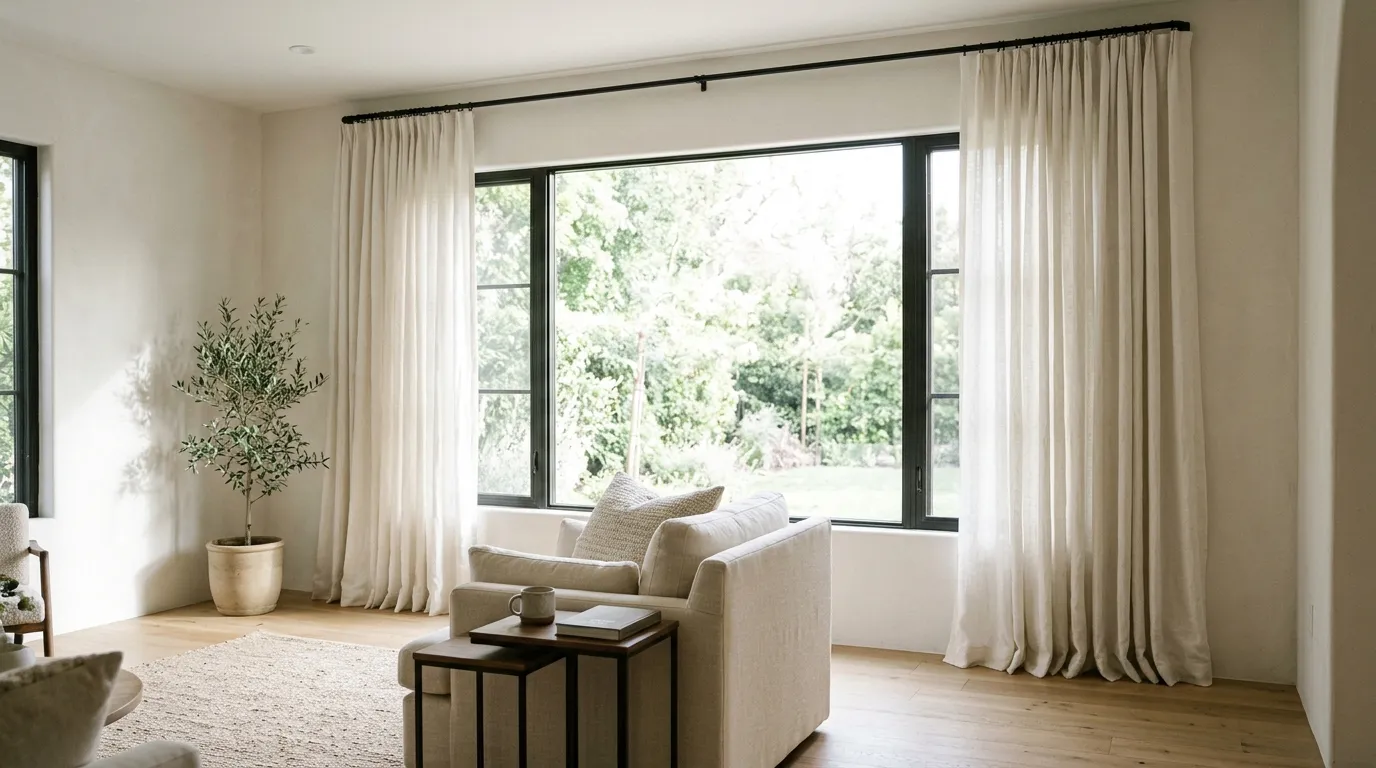
What the calculator tells you
After you tap Calculate, you get four results. Here is what each one means and how it is worked out.
- Rod length. Your window width plus 6 inches on each side (12 inches in total). That gives the panels room to rest beside the glass instead of covering it.
- Mounting height. The distance from the floor to the rod. The calculator places it 5 inches above the top of the window frame, and never closer than 3 inches to the ceiling.
- Fabric width and panels. The rod length multiplied by your fullness, divided by 50 inches (a typical panel width). The calculator rounds up and then to an even number, because panels are sold and hung in pairs.
- Curtain length. The mounting height minus half an inch, so the curtains hover just above the floor. It then shows the closest standard length that is long enough.
Treat the answers as a strong starting point. Always compare them with the real sizes sold in the store you plan to use.
How to measure your window
You need three measurements. Use a metal tape measure, write the numbers down and measure twice.
- Window width. Measure across the window, including the frame (the trim around the glass).
- Floor to top of the window frame. Measure straight up from the floor, not from the sill.
- Floor to ceiling. This lets the calculator keep the rod from landing too close to the ceiling. If the floor is uneven, measure at the window itself.
- A Rod length: window width plus 12 in.
- B Mounting height: floor to rod, about 5 in above the window frame.
- C Curtain length: B minus half an inch.
Fullness: how much fabric you need
Fullness is the ratio between the width of the fabric and the width of the rod. Flat fabric stretched across a window looks like a sheet. Extra fabric creates the soft folds that make curtains look rich.
| Fullness | Look when closed | Best for |
|---|---|---|
| Light (1.5×) | Relaxed, shallow folds, a more tailored line | Modern or minimal rooms, budget projects, lightweight fabrics you rarely close |
| Standard (2×) | Full, gathered folds without feeling bulky | Most living rooms, bedrooms and dining rooms |
| Luxe (2.5×) | Deep, dramatic waves | Formal rooms, sheer fabrics and layered looks |
Sheer and lightweight fabrics look best with more fullness, since thin fabric needs extra volume to look full. Heavy fabrics such as velvet are often fine at standard fullness.
Rod width and mounting height
Go wider than the window
The most common beginner mistake is hanging the rod exactly as wide as the window frame. When the curtains are open, they then cover part of the glass and block light. A wider rod lets the panels stack on the wall beside the window instead.
The calculator adds 6 inches on each side, which is a practical minimum for most windows. If you want the panels to clear the glass completely, extend the rod further, up to 10 to 12 inches per side as suggested in the designer tips. Just remember to recalculate the panels, because a longer rod needs more fabric.
Go higher than the window
Mounting the rod 4 to 6 inches above the frame draws the eye up and makes the window look taller. If you have the space, hang it even higher, a few inches below the ceiling, to make the whole room feel taller. This “high and wide” trick is one of the cheapest ways to make a room look more expensive.
Check for obstacles first. Crown molding, a vent above the window or a ceiling beam may stop you from mounting the rod where you want. Hold the rod in place with a helper before you drill.
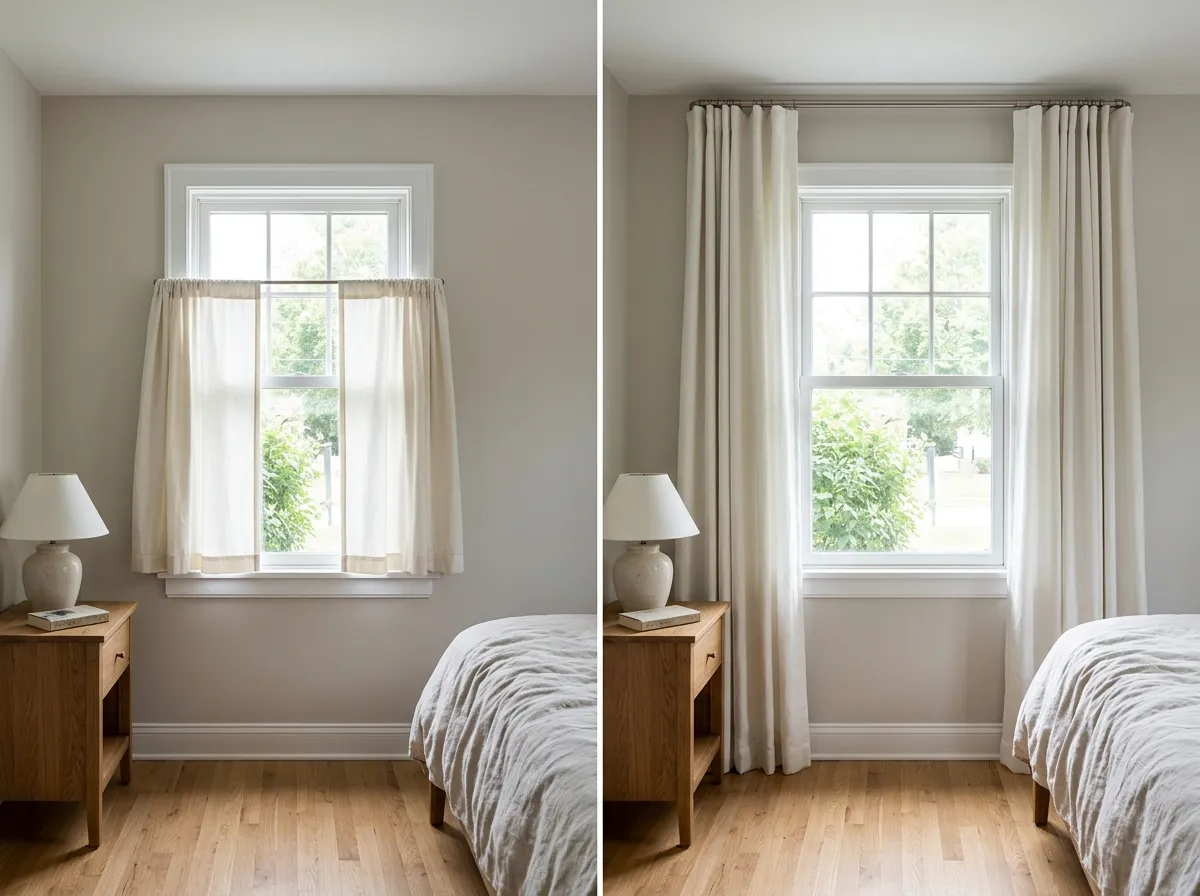
How many panels to buy
Most ready-made panels are about 50 inches wide, but some are 52 or 54, so check the label. The calculation is simple: take your rod length, multiply by the fullness, and divide by the panel width. Round up, then round up again to an even number so each side of the window gets the same amount.
| Window width | Rod length | Fabric at 2× | Panels (50 in each) |
|---|---|---|---|
| 24 in | 36 in | 72 in | 2 |
| 36 in | 48 in | 96 in | 2 |
| 48 in | 60 in | 120 in | 4 |
| 60 in | 72 in | 144 in | 4 |
| 72 in | 84 in | 168 in | 4 |
| 96 in | 108 in | 216 in | 6 |
Values follow the calculator’s logic with standard fullness. Rounding to an even number means you sometimes get slightly more fabric than the minimum, which is a good thing.
Choosing the right length
Length is where most curtains go wrong. The calculator aims for floor-length curtains that hover about half an inch above the floor. That gap keeps the hem clean and lets the curtains swing freely. If your panels are slightly too long, you can hem them or use clip rings to adjust the drop.
Common standard lengths
| Panel length | Typical use |
|---|---|
| 63 in | Sill-length or apron-length curtains for kitchens and small windows |
| 84 in | Floor-length curtains on standard 8-foot rooms where the rod is not mounted very high |
| 95 or 96 in | The most common floor-length size, for 8-foot and many 9-foot ceilings |
| 108 in | Taller windows and 9-foot ceilings, especially with a high-mounted rod |
| 120 to 144 in | 10 to 12 foot ceilings, large windows and statement rooms |
Floor-length, sill-length or puddled?
- Floor-length looks polished and works in almost every room. This is the calculator’s default.
- Sill-length is practical where furniture, a radiator or a kitchen counter sits under the window. Mount the rod 4 to 6 inches above the frame and let the panels end just below the sill.
- Puddled curtains rest several inches on the floor for a dramatic look. They collect dust and wear faster, so they suit formal rooms more than busy ones.
Want to try your own numbers? Back to the calculator ↑
Worked examples
These examples use the same logic as the calculator, so you can check your own results against them.
| Window | Fullness | Rod | Mount height | Panels | Length needed → standard |
|---|---|---|---|---|---|
| 36 in wide, frame top at 72 in, 96 in ceiling | 2× | 48 in | 77 in | 2 | 76.5 in → 84 in |
| 60 in wide, frame top at 80 in, 96 in ceiling | 2× | 72 in | 85 in | 4 | 84.5 in → 95 in |
| 72 in wide, frame top at 84 in, 108 in ceiling | 2.5× | 84 in | 89 in | 6 | 88.5 in → 95 in |
| 48 in wide, frame top at 90 in, 96 in ceiling | 1.5× | 60 in | 93 in | 2 | 92.5 in → 95 in |
Notice the last row. The window frame sits so close to the ceiling that the calculator stops the rod 3 inches below it rather than 5 inches above the frame. That is the “never closer than 3 inches to the ceiling” rule at work.
Header styles and fabric
The way a curtain attaches to the rod changes how it looks and how easily it slides.
| Header style | Look | Slides easily? | Good to know |
|---|---|---|---|
| Grommet | Modern, even wave folds | Yes | Works well on simple rods; the metal rings add a clean line |
| Rod pocket | Casual, gathered at the top | Not very | Best for curtains you rarely open; the rod hides in the fabric |
| Back tab | Tailored and flat at the top | Moderate | Hides the rod from the front; folds are neat and uniform |
| Pinch pleat | Formal, structured pleats | Yes, with hooks and rings | Stacks neatly; best for heavier fabrics in formal rooms |
| Tab top | Relaxed, informal | Not very | Shows the rod; suits casual or farmhouse spaces |
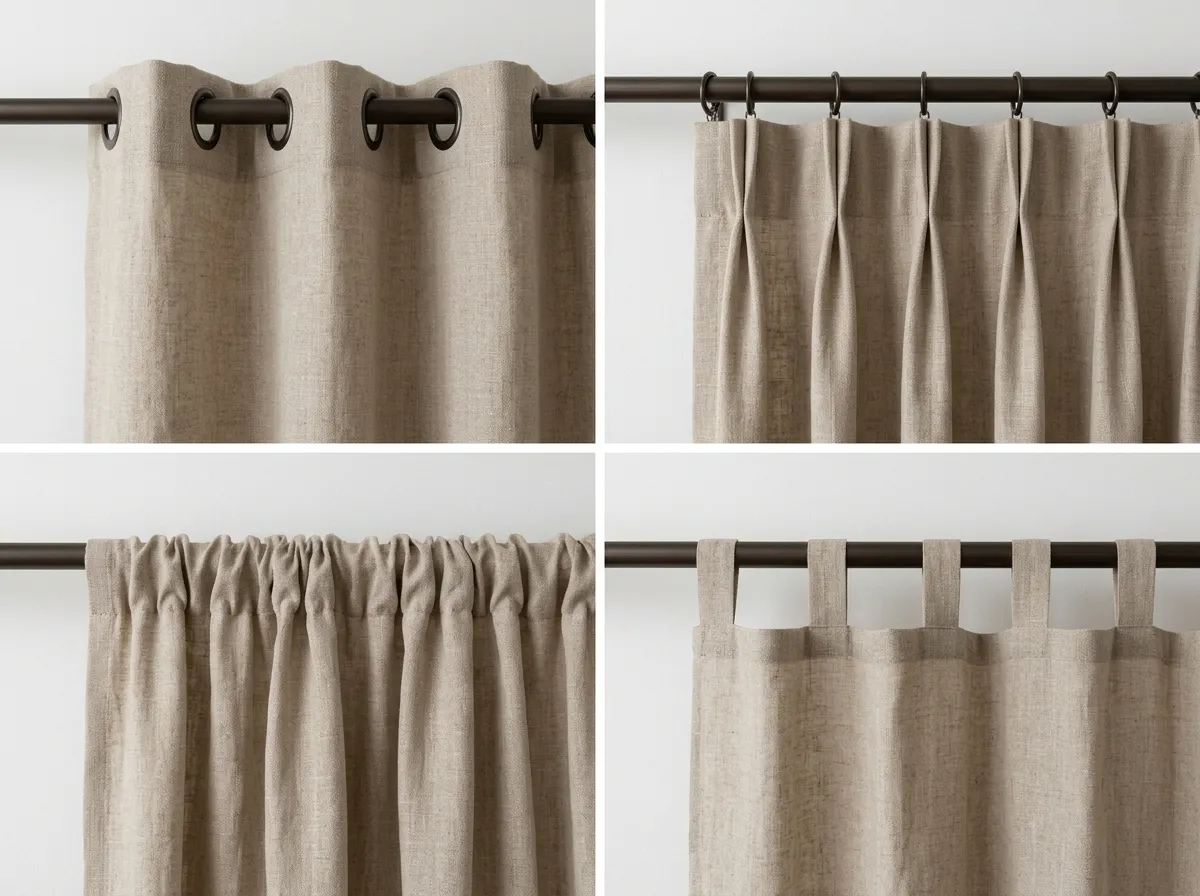
Matching fabric to the room
- Sheer curtains filter light and add softness. Use more fullness for a pleasing drape.
- Light-filtering curtains keep privacy while letting in daylight. They suit living rooms and kitchens.
- Blackout or lined curtains block light and help with sleep. They suit bedrooms and nurseries.
- Heavy fabrics like velvet or thick linen need a sturdy rod and strong brackets.
Curtain color works as a large part of your palette, usually the “30%” in the 60-30-10 rule. If you are still choosing colors, try our Color Palette Generator first. To plan how much daylight and lamp light a room needs, use the Lighting Calculator.
Special situations
- Renting. Use a tension rod or adhesive hooks to avoid drilling, and check the weight limit. Heavy panels can pull them down, so choose lighter fabric.
- Very wide windows or sliding doors. Use several panels on a long rod and consider a traversing (track) rod so the curtains open fully. Plan for stack-back space at the sides.
- Two windows close together. Treat them as one wide window with a single rod. It looks calmer and more intentional.
- Bay windows. Use a bay rod or individual rods on each section. Measure each section separately.
- Low ceilings. Mount the rod as close to the ceiling as the calculator allows and choose vertical stripes or a solid color to add height.
- Radiators or furniture under the window. Choose sill-length curtains so heat and furniture are not blocked.
Common mistakes to avoid
- Hanging the rod at the frame. Curtains then look short and the window looks small. Go higher and wider.
- Buying only one panel per side with too little fabric. Thin curtains look flat. Aim for at least 1.5× fullness.
- Choosing a length that is too short. Curtains that stop an inch or two above the floor often look like a mistake. Either hover just above the floor or choose a clear sill length.
- Ignoring the panel width on the label. A pair of 52-inch panels is not the same as a pair of 50-inch panels, and it changes how many you need.
- Measuring from the sill. Always measure from the floor so the length is correct.
- Underestimating the weight. Heavy or lined curtains need strong brackets, and a center support for wide rods.
- Ordering before checking the stack-back space. Make sure there is wall space at each side for the panels to rest.
Before you buy: checklist
Tick these off before you place an order.
More questions
The most common questions are answered in the calculator above. Here are a few more.
How many curtain panels do I need for one window?
Most windows need a pair, which means two panels, one for each side. Wider windows may need four or six panels. The calculator rounds up to an even number so both sides match.
Should curtains touch the floor?
It is a style choice. Most designers prefer curtains that hover about half an inch above the floor for a clean look. Curtains that just touch the floor or puddle slightly look more traditional, but collect dust faster.
Can I use centimeters in the calculator?
The calculator uses inches. To convert, divide your centimeter measurement by 2.54. For example, 150 cm is about 59 inches. You can also use the converter above.
What if my curtains are slightly too long or too short?
Slightly long curtains can be hemmed, taped or adjusted with clip rings. If they are too short, you can lower the rod a little, add a fabric border or choose a longer panel next time.
Ready to measure? Scroll back up, enter your window measurements and get your numbers in seconds. Once the curtains are sorted, the next step is making sure the room has the right light.