How Many Lumens Does Your Room Need?
A room that feels dim usually has too few lumens, or all of them in one overhead fixture. Choose your room type and size, and this calculator estimates the total light you need and how to split it into layers that feel warm and comfortable.
- Enter the room length, width and ceiling height in feet.
- Choose the room type, since kitchens and bathrooms need more light than bedrooms.
- Pick your wall color. Dark walls absorb light, so the room needs more lumens.
- Tap Calculate lumens, then check the lumens printed on the bulb box, not the watts.
- Use at least three light sources in every room so no single fixture does all the work.
- Choose 2700 K bulbs for a cozy glow and 3000 to 4000 K for kitchens, bathrooms and desks.
- Put lamps on dimmers or smart plugs to change the mood in the evening.
- A lamp at eye level in a corner makes a small room feel larger than one bright ceiling light.
What are lumens?
Lumens measure how much light a bulb gives off. Watts only measure how much electricity it uses.
How many lumens do I need per square foot?
As a general guide, about 10 to 20 for living areas and bedrooms, 30 to 40 for kitchens and 50 for bathrooms and workspaces. The calculator uses these numbers.
Is this exact?
No. It is a planning guide. Age, eyesight, daylight and personal taste all change how much light feels right.
What bulb is 800 lumens?
A standard 60 W equivalent LED bulb, usually labeled 9 W, gives about 800 lumens.
Read the full lighting guide ↓
How Much Light Does a Room Really Need? A Practical Guide to Lumens
Most rooms are not dim because the bulbs are weak. They are dim because all the light comes from one ceiling fixture, and nothing lights the places where you actually read, cook or work.
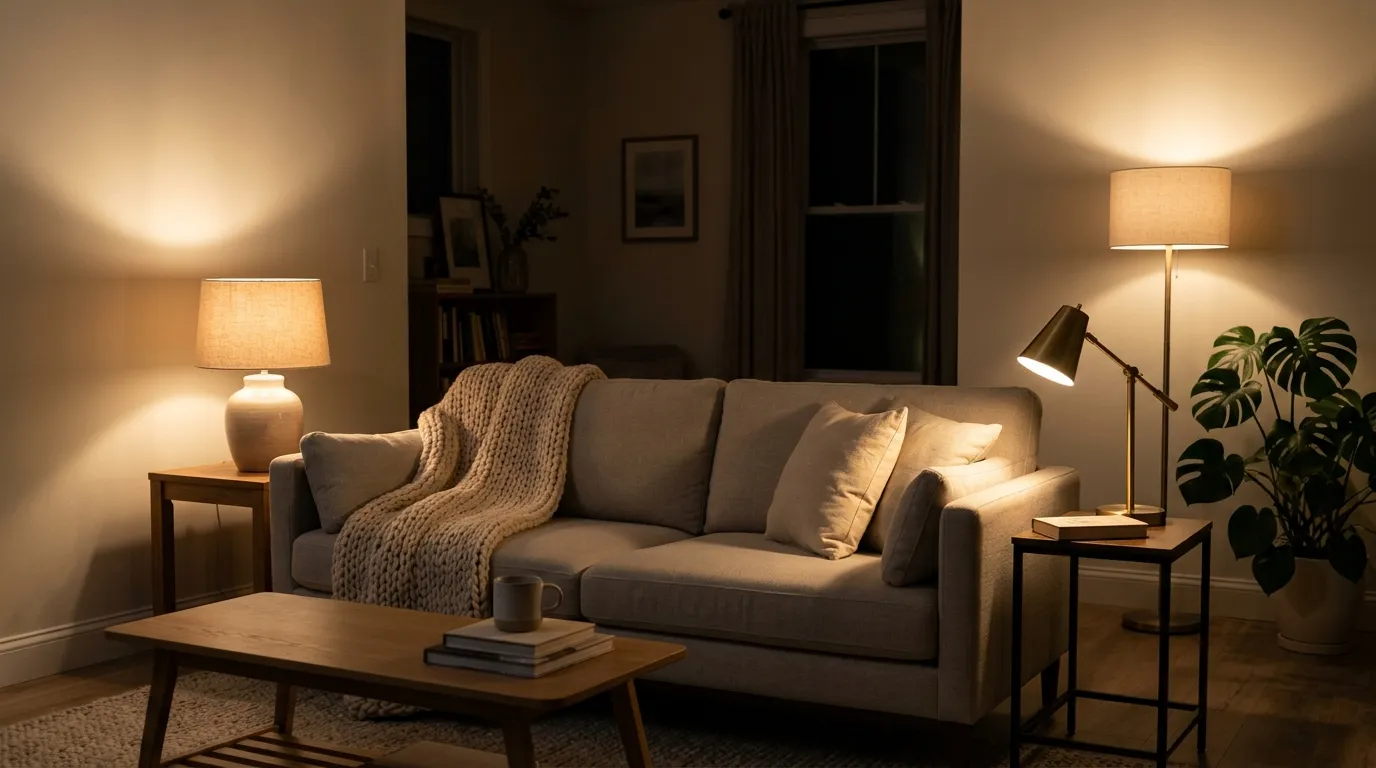
The calculator above turns your room size, ceiling height and wall color into a total number of lumens, then splits that number into three layers. This guide explains where those numbers come from, how to read a bulb box, and how to turn the result into a room that feels warm instead of flat.
How the calculator works
- Enter the room length, width and ceiling height in feet. If you leave the ceiling height empty, the calculator assumes 8 feet.
- Choose the room type. A bathroom needs far more light per square foot than a bedroom.
- Pick the wall color: light, medium or dark. Darker walls soak up light, so the total goes up.
- Tap Calculate lumens. You get the room area, the total lumens, a rough count of 800-lumen bulbs and the split into ambient, task and accent light.
- Shop by lumens. Compare the number on the bulb box with your result. Ignore the watts.
If you do not enter a length and a width, the calculator asks for them instead of showing a result.
What to measure first
- Length and width of the room. Measure the floor from wall to wall in feet. For an L-shaped room, measure each part and add the areas, or use our Room Size Calculator.
- Ceiling height. Measure from the floor to the ceiling. Anything above 8 feet adds to the total.
- Wall color. Use light for white, cream and pale tints, medium for mid-tones, and dark for deep or saturated colors. If you plan to repaint, work out the quantity with the Paint Calculator and use the new color here.
- What the room is used for. A living room that doubles as a home office needs both the living room number and a strong task light at the desk.
- Your current fixtures. Note how many sources you have, what each bulb gives in lumens, and the maximum wattage printed on each fixture.
The calculator does not count daylight. It plans for the evening, when the lamps do all the work.
How the number is calculated
The calculator multiplies four things together:
Room area × lumens per square foot × ceiling factor × wall color factor
- Lumens per square foot depends on the room type: 20 for a living room, 15 for a bedroom, 30 for a dining room, 40 for a kitchen, and 50 for a bathroom or home office.
- Ceiling factor: add 10% for every foot above 8 feet. A ceiling at 8 feet or lower adds nothing.
- Wall color factor: 1 for light walls, 1.15 for medium and 1.3 for dark.
The total is then rounded to the nearest 100 lumens. Ambient and task are rounded to the nearest 100 as well, and accent gets what is left, so the three layers always add up to the total. The bulb count is the exact total divided by 800 and rounded up to the next whole bulb.
Worked example
Take a 12 × 10 ft living room with 9 ft ceilings and medium-colored walls.
- Area: 12 × 10 = 120 sq ft.
- Base light: 120 × 20 = 2,400 lumens.
- Ceiling factor: one foot above 8 ft, so × 1.1 = 2,640.
- Wall factor: medium walls, so × 1.15 = 3,036, which rounds to 3,000 lumens.
- Bulbs: 3,036 ÷ 800 = 3.8, so 4 bulbs of 800 lumens.
- Layers: about 1,800 ambient, 900 task and 300 accent.
The bulb count uses the exact total before rounding. That is why an 11 × 11 ft living room shows about 2,400 lumens but 4 bulbs: the exact figure is 2,420, which is just over three bulbs.
Lumens by room type
This table shows one example room per type, with light walls and 8 ft ceilings. It is a quick way to sense-check your own result.
| Room type | Lumens per sq ft | Example room | Total lumens | Bulbs of 800 lm |
|---|---|---|---|---|
| Living room | 20 | 12 × 10 ft | 2,400 | 3 |
| Bedroom | 15 | 12 × 12 ft | 2,200 | 3 |
| Dining room | 30 | 12 × 14 ft | 5,000 | 7 |
| Kitchen | 40 | 10 × 12 ft | 4,800 | 6 |
| Bathroom | 50 | 5 × 8 ft | 2,000 | 3 |
| Home office | 50 | 10 × 10 ft | 5,000 | 7 |
The bedroom comes to 2,160 lumens before rounding, and the dining room to 5,040.
The same 12 × 10 ft footprint shows how much the room type matters: about 1,800 lumens as a bedroom, 2,400 as a living room, 3,600 as a dining room, 4,800 as a kitchen and 6,000 as a bathroom or office. Rooms where you cut, read, shave or write need the most light because your eyes need to see detail.
Ceiling height and wall color
Two rooms with the same floor size can need very different amounts of light. Taller ceilings spread the light over more space, and dark walls absorb it. This table uses the same 12 × 10 ft living room from above and changes only the ceiling and the walls.
| Ceiling height | Light walls | Medium walls | Dark walls |
|---|---|---|---|
| 8 ft | 2,400 | 2,800 | 3,100 |
| 9 ft | 2,600 | 3,000 | 3,400 |
| 10 ft | 2,900 | 3,300 | 3,700 |
| 12 ft | 3,400 | 3,900 | 4,400 |
Total lumens for a 12 × 10 ft living room, rounded to the nearest 100.
Painting a room dark can add 30% to the light it needs. If you love a moody color, plan for more lamps, and pick a finish that is not completely flat. Our Color Palette Generator helps you choose the shade first, so you can come back here with the right wall color.
Splitting light into layers
The total is only half the answer. The calculator also splits it into three layers, because a room lit from one fixture feels flat even when it is bright.
- Ambient (60%). The general glow of the room. Ceiling fixtures, floor lamps and wall lights do this job.
- Task (30%). Light where you work: a reading lamp, a desk lamp, under-cabinet lights or a mirror light.
- Accent (10%). Small, focused light on things you want to show off, such as shelves, plants or art.
- Accent is the thin slice on the right: just 10% of the total, but it adds the depth.
- The calculator rounds ambient and task to the nearest 100 and gives the rest to accent, so the three numbers always add up to the total (here 1,400 + 700 + 300 = 2,400). That is why accent can come out a little above 10%.
Here is how the split looks for a typical room of each type, using light walls and 8 ft ceilings.
| Room | Total | Ambient | Task | Accent | Bulbs of 800 lm |
|---|---|---|---|---|---|
| Living room (12 × 10 ft) | 2,400 | 1,400 | 700 | 300 | 3 |
| Bedroom (12 × 10 ft) | 1,800 | 1,100 | 500 | 200 | 3 |
| Dining room (12 × 10 ft) | 3,600 | 2,200 | 1,100 | 300 | 5 |
| Kitchen (12 × 10 ft) | 4,800 | 2,900 | 1,400 | 500 | 6 |
| Bathroom (8 × 5 ft) | 2,000 | 1,200 | 600 | 200 | 3 |
| Home office (10 × 10 ft) | 5,000 | 3,000 | 1,500 | 500 | 7 |
Lumens, rounded to the nearest 100. Accent is the remainder, so each row adds up to its total. The bulb count comes from the exact total.
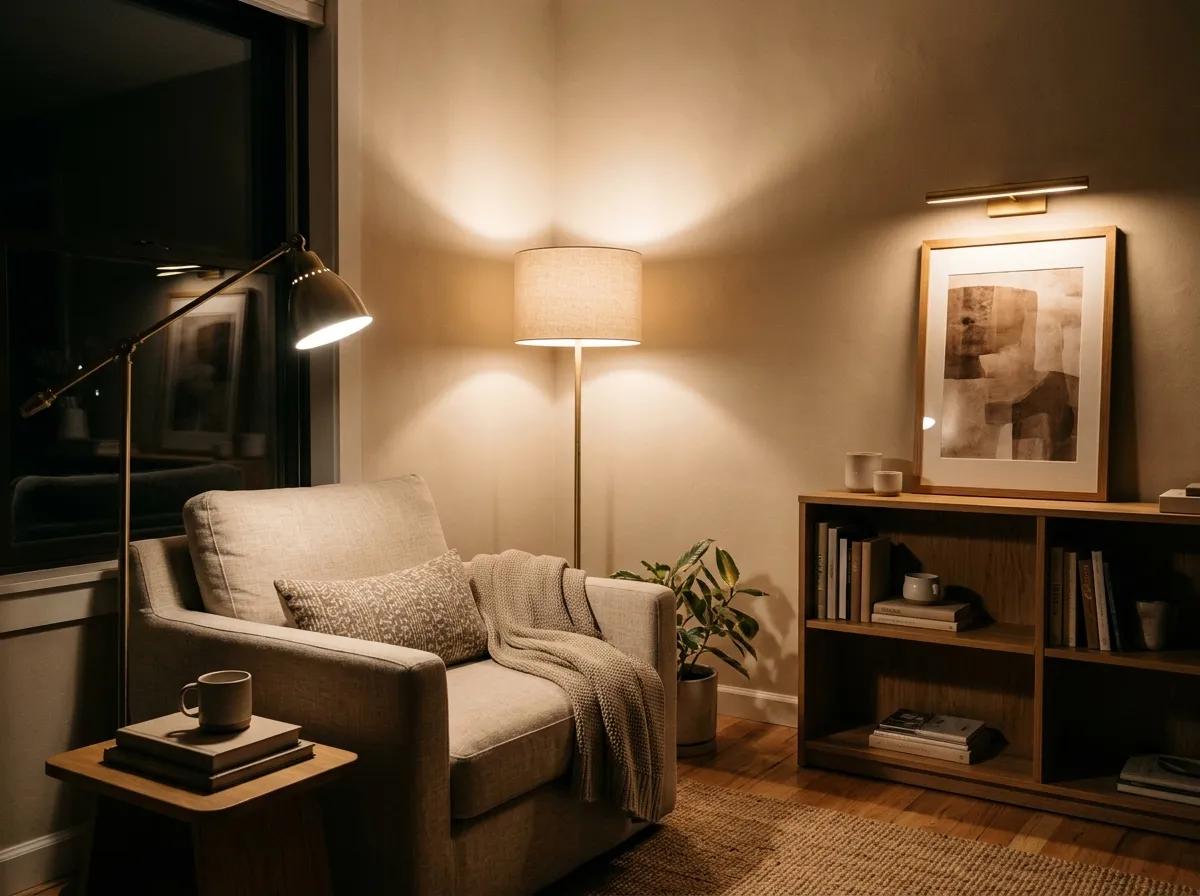
Use the layers as a shopping list. In the living room above, one 800-lumen bulb in a ceiling or floor lamp would not be enough for the 1,400 ambient lumens, so you might use two lamps. The 700 task lumens could be a bright reading lamp beside the sofa, and the 300 accent lumens a small picture light or shelf light. If you have art to highlight, our Gallery Wall Planner helps you place it first.
Reading the bulb box
Lumens measure how much light a bulb gives off. Watts only measure the electricity it uses. LED bulbs use far fewer watts for the same light, so the old rule of buying by watts no longer works. The calculator counts bulbs in units of 800 lumens, which is the size of an old 60 W bulb and a typical LED labeled 9 W.
These are the usual lumen ranges for the old bulb sizes, which many LED boxes still use as a comparison. Treat them as about figures, since brands vary.
| Old bulb size | About how many lumens | Where it fits |
|---|---|---|
| 40 W | 450 | Accent lamps, small shades, candle-style bulbs |
| 60 W | 800 | The standard size the calculator uses for its bulb count |
| 75 W | 1,100 | Floor lamps, kitchens, rooms with dark walls |
| 100 W | 1,600 | Large rooms, workspaces, bright task lamps |
A note on safety: This calculator is a planning guide, not electrical or lighting design advice. Check the maximum wattage and the bulb type printed on every fixture, use dimmable bulbs on dimmers, and ask a licensed electrician before you add new wiring or fixtures.
Choosing color temperature
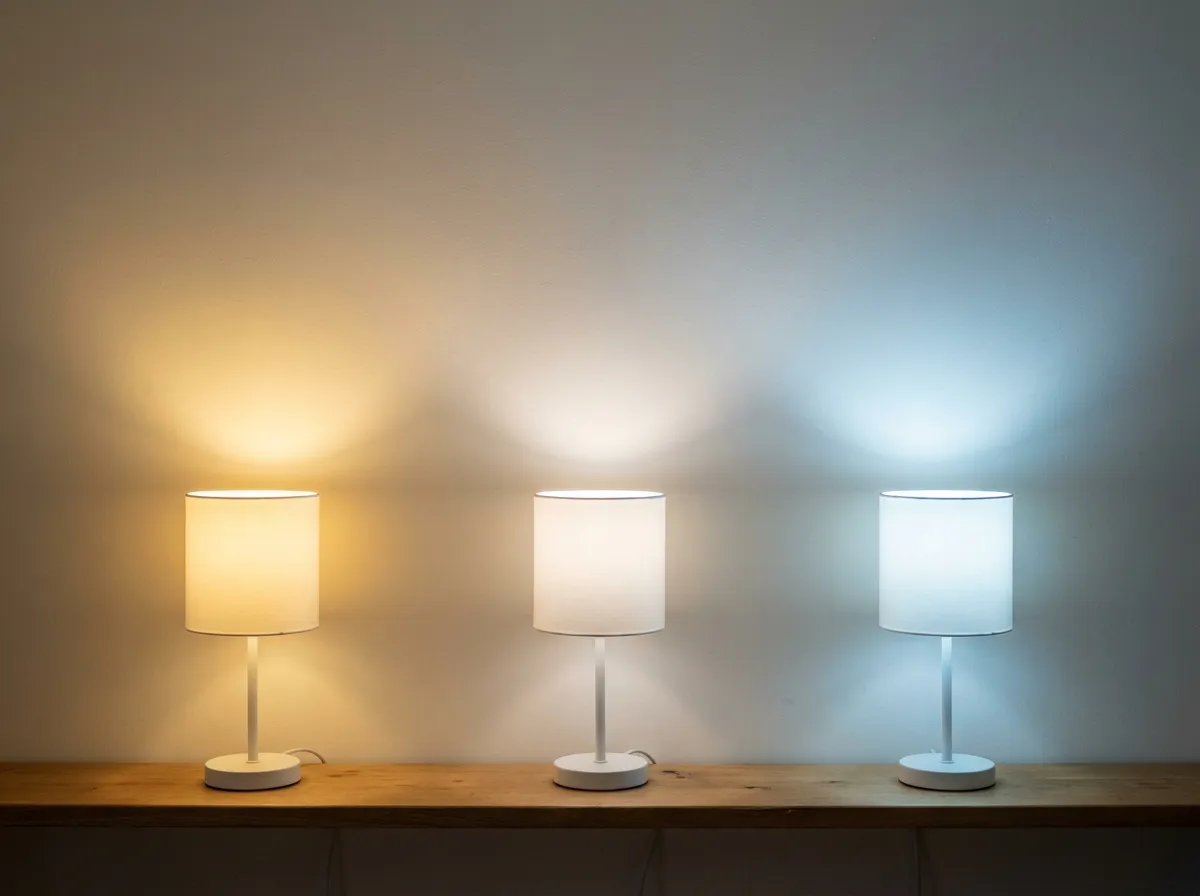
Color temperature is measured in kelvins (K) and printed on the bulb box. Lower numbers look warm and yellow. Higher numbers look cool and blue-white. Two bulbs with the same lumens can feel completely different, so check this number too.
- 2700 K: warm white. The cozy choice for living rooms and bedrooms.
- 3000 K: soft white. A little crisper, good for kitchens and bathrooms that you still want to feel warm.
- 4000 K: neutral white. A clean light for kitchens, bathrooms and desks.
- 5000 K: daylight. Very crisp, and often feels harsh in a home, so it suits garages and workshops better than living spaces.
Keep every bulb in one room at the same color temperature. A 2700 K lamp next to a 4000 K ceiling light looks like a mistake. It also helps to look for a high color rendering index (CRI), often printed as 90+, so skin tones, wood and fabrics look natural.
Do your bulbs add up?
Once you have your total, count what you already have. Enter the lumens you need, the number of bulbs and the lumens on each bulb box to see how close you are.
The 10% and 25% limits are a rule of thumb for this guide, not part of the calculator. Use the same bulb size for the check, or enter the average.
Want to try your own room? Back to the calculator ↑
Tips room by room
Living room
Skip the single ceiling light as your main source. Use two or three lamps at different heights so the corners glow, and put a dimmer on whatever you keep overhead. A lamp at eye level in a corner makes a small room feel bigger.
Bedroom
The bedroom has the lowest number in the calculator, because you want it calm. Put a lamp on each side of the bed for reading, choose 2700 K bulbs and use dimmers so the room can wind down at night. Curtains matter too, so check the Curtain Size Calculator if you want to control the morning light.
Kitchen
Kitchens need a lot of light, and most of it should land on the counters. Ceiling lights alone cast shadows from your own body, so add under-cabinet lights for the task layer. A 3000 to 4000 K bulb keeps food and surfaces looking clean.
Bathroom
Light on both sides of the mirror shows your face evenly. A single fixture above it throws shadows under the eyes. Use bulbs and fixtures rated for damp rooms.
Dining room
A pendant over the table sets the mood, and a dimmer lets the same room work for homework and for dinner parties. Hang the pendant at a height where you can still see the person across the table, usually about 30 to 36 inches above the tabletop.
Home office
Give the desk its own bright lamp and keep the rest of the room softer so the screen does not fight with glare. Place the lamp on the side opposite your writing hand to avoid shadows. If space is tight, test whether the lamp fits with our Furniture Layout Planner before you buy.
Budgeting for the whole room? Lamps, shades and good bulbs add up quickly, so include them in your plan with the Decorating Budget Planner. And if you are adding a patterned accent wall, the Peel-and-Stick Wallpaper Calculator tells you how many rolls to buy, which also changes how much light the wall reflects.
Common mistakes
- Relying on one ceiling light. Even a very bright fixture lights the room flatly. Use at least three sources.
- Buying by watts. Always compare lumens.
- Ignoring wall color. A dark room can need about 30% more light than a pale one.
- Mixing color temperatures. Keep every bulb in a room within the same range.
- Skipping dimmers. One bright setting is never right for both a workday and a quiet evening.
- Skipping task light. Kitchens, desks and mirrors need light where the work happens, not just overhead.
- Ignoring the fixture rating. Check the maximum wattage and bulb type on the fixture before you screw in a brighter bulb.
- Counting on daylight. The calculator plans for the evening, so plan for it.
Before you buy: checklist
Tick these off before you order bulbs.
More questions
The most common questions are answered in the calculator above. Here are a few more.
How many lumens do I need in a bedroom?
The calculator uses 15 lumens per square foot for bedrooms. A 12 × 10 ft bedroom with 8 ft ceilings and light walls comes to about 1,800 lumens, which is roughly 3 bulbs of 800 lumens.
Does the calculator count daylight from windows?
No. It plans for the evening and for cloudy days, when your lamps provide all of the light. Daylight is a bonus, not part of the total.
Can I put a brighter bulb in any fixture?
Not always. Every fixture has a maximum wattage and a bulb type printed on it. Stay within that rating, use dimmable bulbs on dimmers, and ask an electrician if you are unsure.
Why does the calculator show more bulbs than the lumens suggest?
The bulb count is based on the exact total, which is rounded up to a whole bulb. The lumens shown are rounded to the nearest 100. For example, an 11 × 11 ft living room needs 2,420 lumens, shown as about 2,400, but that is just over three 800-lumen bulbs, so the calculator shows 4.
Ready to plan your lighting? Scroll back up, enter your room and see the lumens you need. Once the lights are sorted, you can move on to the walls.