Furniture Doorway and Hallway Checker
There is nothing worse than a new sofa stuck in the stairwell. Enter your furniture size and the width and height of the doorway, and this checker tells you if it should fit. Add hallway widths to estimate a turn.
- Measure your item at its widest, deepest and tallest points.
- Measure the clear opening of the doorway. Open the door fully and measure the narrowest point.
- Measure any hallway that has a turn. Enter the second hallway width to check the corner, or 0 to skip it.
- Tap Check if it fits.
- Remove doors from their hinges and legs from sofas and tables before moving them.
- Measure stairwells, elevators and ceiling height at the entrance, not only the doorway.
- Tape the item size on the floor and walk the path before you order.
- Check the return policy. Many stores charge a restocking fee for large furniture.
How do I measure a doorway?
Measure the narrowest clear width with the door open. Door stops and hinges often take 1 to 2 inches off the opening.
Why does the tool say a big sofa fits a small door?
A long item can pass through a narrow door if its two smaller sides fit and you slide it through end first.
How accurate is the hallway turn?
It is a rough estimate for a simple right-angle corner. Real turns depend on the item shape and how you tilt it.
Can I tilt furniture to get it through?
Often yes, but the tool plays it safe and does not rely on tilting. A tight fit may still work with careful handling.
Read the full “will it fit” guide ↓
How to Know Your Furniture Will Fit Before It Is Delivered
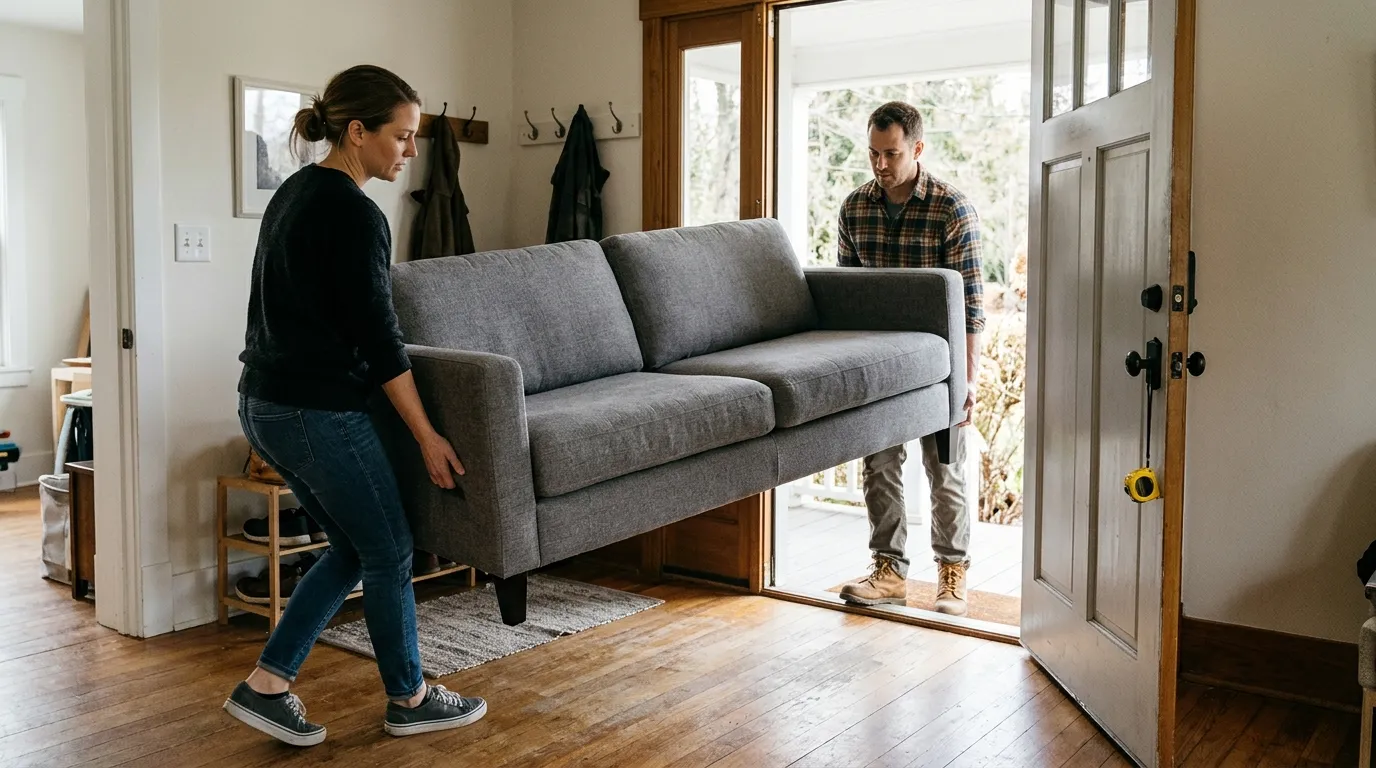
Most furniture disasters do not happen in the room. They happen on the way to it: the sofa that jams in a stairwell, the dresser that will not turn the corner, the bed frame that clears the front door by half an inch and then meets a narrower bedroom door. A five-minute check with a tape measure prevents nearly all of it.
The checker above tests two things: whether an item can pass through a doorway, and whether it can get around a simple right-angle turn in a hallway. This guide explains exactly how those checks work, what to measure and where, what the results mean, and what to do when the answer is “no” or “very tight.”
How the checker works
- Enter the item’s width, depth and height in inches. The order does not matter, because the checker sorts the three numbers from smallest to largest.
- Enter the doorway’s clear width and height. Use the narrowest points you can measure with the door open.
- Optionally add hallway widths. Enter the width of the hallway you are coming from and of the hallway you are turning into. Leave the second one at 0 to skip the corner check.
- Tap Check if it fits. You get a doorway verdict and, if you entered two hallway widths, a rough verdict for the turn.
The checker is deliberately cautious. It leaves a margin on both checks and does not count on tilting or other clever handling, so a “should fit” is a good sign and a “very tight” is a reason to test further, not a final no.
A note on safety and accuracy. The checker and this guide are general planning aids, not professional advice. Moving large furniture is heavy work, so get a helper, lift with your legs and take doors and legs off before you push, not after something is stuck. Always recheck stairs, elevators and tight turns on site.
What to measure
Good measurements matter more than a good calculator. Write every number down before you enter it.
| What | How to measure it | Checker field |
|---|---|---|
| Item width | The widest point left to right, including arms, handles and any overhang | Item width |
| Item depth | The deepest point front to back, including feet and a curved back | Item depth |
| Item height | The tallest point from floor to top, with legs on | Item height |
| Doorway width | The narrowest clear width with the door open. Door stops and hinges often take 1 to 2 inches off the opening | Doorway width |
| Doorway height | Floor to the lowest point of the frame, including any threshold | Doorway height |
| Hallway width | Wall to wall at the narrowest point, including trim, radiators and railings that stick out | Hallway width |
| Second hallway width | The same measurement for the hallway on the other side of the turn | Second hallway width |
Measure the item at its largest points, not the points listed in a showroom. Product pages often give the body size and leave out feet, arms or pillows. If you are unsure, trust your own tape.
For doorways, open the door as far as it goes and measure the narrowest gap. If you will remove the door from its hinges, measure again without it. For halls, check the full length, not just the corner, since a light switch or a radiator can narrow a hall in one spot.
How the doorway check works
The doorway check is based on a simple idea: a long item passes through a door end first, so only its two smaller sides have to fit through the opening.
The checker sorts your three item sizes from smallest to largest. The smallest and middle sizes form the item’s “cross-section,” and the largest size is the length that slides through behind it. It then tests two ways of turning the item:
- The smallest side goes across the doorway width and the middle side goes up the doorway height.
- Or the middle side goes across the width and the smallest side goes up the height, for items you can turn on their side.
In either case, each side must be at least 1 inch smaller than the opening. That is the checker’s safety margin, and it applies as one inch of total spare room, not one inch on each side.
- Width check: 34 in is at most 36 − 1 = 35 in, so the item clears the width.
- Height check: 36 in is at most 80 − 1 = 79 in, so the item clears the height.
- Length: the 84 in side is not tested, because it slides through end first.
The longest side is not tested for the doorway at all. That is why the checker can say a very long sofa fits through a narrow door, which is one of the questions in the tool’s FAQ. It also means the checker does not worry about the space needed to swing the item around inside the room.
How much doorway do different items need?
The table below uses a set of example items, not standard sizes. It shows the smallest opening each one needs, and whether it passes doorways of four common clear widths at 80 inches tall. The results come straight from the checker’s rule.
| Example item (W × D × H) | Opening needed (W × H) | 28 in door | 30 in door | 32 in door | 36 in door |
|---|---|---|---|---|---|
| Armchair 32 × 34 × 36 | 33 × 35 | No | No | No | Yes |
| Loveseat 60 × 34 × 33 | 34 × 35 | No | No | No | Yes |
| Sofa 84 × 36 × 34 | 35 × 37 | No | No | No | Yes |
| Dresser 60 × 18 × 32 | 19 × 33 | Yes | Yes | Yes | Yes |
| Desk 48 × 24 × 30 | 25 × 31 | Yes | Yes | Yes | Yes |
| Refrigerator 36 × 30 × 70 | 31 × 37 | No | No | Yes | Yes |
Opening needed is the smallest side plus 1 in across, and the middle side plus 1 in up (or the other way around). Example sizes only. Measure your own piece.
Notice how deep, boxy pieces like sofas and armchairs struggle with ordinary doors, while a long, shallow dresser sails through. A piece’s thickness matters far more than its length.
How big a doorway do you need?
Enter your item’s size to see the smallest clear opening it needs under the checker’s rule. This is useful when you are shopping, before you have measured any doorway.
The labeled width of a door slab is usually larger than the clear opening, because the stop and hinges take about 1 to 2 inches. The calculator adds that allowance for you.
Want to test your own measurements? Back to the checker ↑
How the hallway turn is estimated
The corner check answers a different question: how long an item can be before it gets stuck turning from one hallway into another. The checker treats the turn as the classic problem of carrying a long ladder around a right-angle corner.
Here is how it works, step by step:
- It takes the item’s smallest side as its thickness.
- It subtracts that thickness from each hallway width. Call the leftovers x and y. If either leftover is zero or less, the longest item that can turn is 0 inches.
- It combines them with the ladder formula: limit = (x2/3 + y2/3)3/2.
- It compares that limit with the item’s longest side. The checker says “should turn the corner” only when the limit is more than 2 inches longer than the item.
- The item has to pivot around the inner corner while touching the outer wall of each hallway.
- The thicker the item, the less room is left in each hallway, and the shorter the item must be to turn.
Because of the formula, thickness has a dramatic effect. The table below shows the rough limit the checker calculates, in inches, for four item thicknesses and four pairs of hallway widths. To get a “should turn the corner” result, the item’s longest side must be more than 2 inches shorter than the limit.
| Item’s smallest side | Halls 36 and 36 | Halls 42 and 42 | Halls 48 and 36 | Halls 48 and 48 |
|---|---|---|---|---|
| 10 in (slim shelf) | 73 | 90 | 89 | 107 |
| 20 in (narrow cabinet) | 45 | 62 | 61 | 79 |
| 28 in (desk, small table) | 22 | 39 | 38 | 56 |
| 34 in (sofa, bulky chair) | 5 | 22 | 20 | 39 |
Rough limit in inches, rounded down, for the longest side that can turn. Hallway widths are in inches.
Two lessons stand out. First, a few inches of hallway width make a big difference: going from 36 to 42 inches on both halls adds 17 inches of limit for a 20 inch thick item. Second, thick pieces such as sofas get stuck very quickly, which is why the checker flags them as “very tight” even in fairly generous halls.
Treat the corner check as a rough guide. It models the item as a simple rectangle in a flat, right-angle turn. Real furniture can be tilted, stood on end or have its legs and back removed, and real hallways can have doors, rails and light fixtures. The checker’s own FAQ says the same: it is an estimate for a simple corner.
Worked examples
Here are four examples, each calculated with the same rules as the checker.
Example 1: the sofa that does not fit a 30 inch door
The checker’s default values describe a sofa 84 inches wide, 36 deep and 34 tall, and a doorway 30 inches wide and 80 tall. The sorted sizes are 34, 36 and 84. The width test needs 34 ≤ 30 − 1 = 29, which fails, and the turned-on-its-side test needs 36 ≤ 29, which fails too. The verdict is that it will not fit.
The checker suggests taking the door off its hinges, which gains about 1.5 inches. Enter 31.5 for the doorway and the width test becomes 34 ≤ 30.5, which still fails. In this case the door is not the answer. This sofa needs a clear opening of at least 35 inches wide, so you would need to remove arms or legs, pick a thinner sofa or use a wider entrance.
Example 2: the same sofa through a 36 inch door
Change the doorway to 36 inches. Now 34 ≤ 35 and 36 ≤ 79, so the checker says it should fit, carried with the 84 inch side going through first. The same sofa passes a 36 inch opening and fails a 30 inch one, so the opening width is the number to watch.
Example 3: a dresser and two hallways
A dresser measuring 60 × 18 × 32 passes a 30 inch door easily, since 18 ≤ 29 and 32 ≤ 79. Now add two 36 inch halls. The smallest side is 18, so each hall has 36 − 18 = 18 inches left. The limit is (182/3 + 182/3)3/2, about 50.9 inches, so the checker reports about 50 inches. The dresser is 60 inches long, so the verdict is “very tight or will not turn.”
Make both halls 42 inches wide and each has 24 inches left, giving a limit of about 67.9 inches. That is more than 62 (the 60 inch length plus the 2 inch margin), so the checker now says it should turn the corner. Six extra inches on each hall changed the answer.
Example 4: a loveseat that is simply thick
A loveseat measuring 60 × 34 × 33 passes a 36 inch door, since 33 ≤ 35 and 34 ≤ 79. For the corner, its smallest side is 33. With two 36 inch halls only 3 inches are left on each, and the limit is about 8 inches. Even with two 48 inch halls the limit is about 42 inches, below the 60 inch length. The checker says “very tight” in both cases.
That does not mean the loveseat is stuck forever. It means you cannot count on carrying it flat around a tight corner. Check whether the legs, back or arms come off, and test the turn with the taped outline described below.
What to try when it does not fit
When the checker says no or “very tight,” work through these options, from cheapest to most drastic. Then re-enter the new numbers to see whether the verdict changes.
| Option | What it can gain | Notes |
|---|---|---|
| Take the door off its hinges | About 1.5 in of doorway width (the checker’s own estimate) | Remove the hinge pins and store the door safely. Measure again with the door off |
| Remove legs or feet | Reduces the item’s height | Re-enter the new height. It only helps if height is one of the two sides being tested |
| Remove arms, back or cushions | Reduces depth or width | Check the manual. Many modular pieces are designed to split apart |
| Choose a slimmer piece | Lowers the smallest side, which matters most | Compare the smallest side of each option, not just the width |
| Use a different entrance | A wider door, patio door or a window | Measure the new route from the street all the way to the room |
| Choose flat-pack or modular | Pieces small enough for any door | Allow time and tools for assembly |
One caution on legs: removing them only helps if the dimension you reduce is one of the item’s two smallest sides. If a sofa is 34 tall and 36 deep, removing 4 inches of leg changes the smallest side from 34 to 30, so the opening it needs drops from 35 inches to 31. If height is already the largest side, it is the length that slides through last and nothing changes.
What the checker does not cover
The checker tests one doorway and one right-angle hallway turn. A real delivery route has more than that. Measure these separately:
- Stairwells. Check the width of the stairs, the headroom above them and the landing where the stairs turn.
- Elevators. Measure the door opening and the interior of the cab, and check any weight limit.
- Ceiling height at the entrance, especially under stair landings, beams and light fixtures.
- Several doors in a row. The narrowest doorway on the route is the one that decides.
- Door swing and nearby walls. A door that opens against a wall may not reach the angle you assumed.
- Outdoor steps and railings, which can narrow the path before the front door.
The checker’s tip is a good rule here: measure stairwells, elevators and ceiling height at the entrance, not only the doorway. Run the checker once for each narrow point, and the smallest passing opening is the one that counts.
Walk the path with tape
Numbers can hide problems that you can see in thirty seconds on the floor. Before you order a big piece, mark its footprint and walk the route.
- Mark the footprint. Use painter’s tape or newspaper to outline the item’s width and depth on the floor of the room where it will go.
- Mark the narrow points. Tape the item’s smallest dimensions on the floor near each doorway or turn.
- Walk the route from the entrance to the room, carrying a cardboard box cut to the item’s cross-section if you can.
- Look up. Check the ceiling, lights and stair headroom, not just the floor.
- Note the tight spots and run the checker again with the numbers for each.
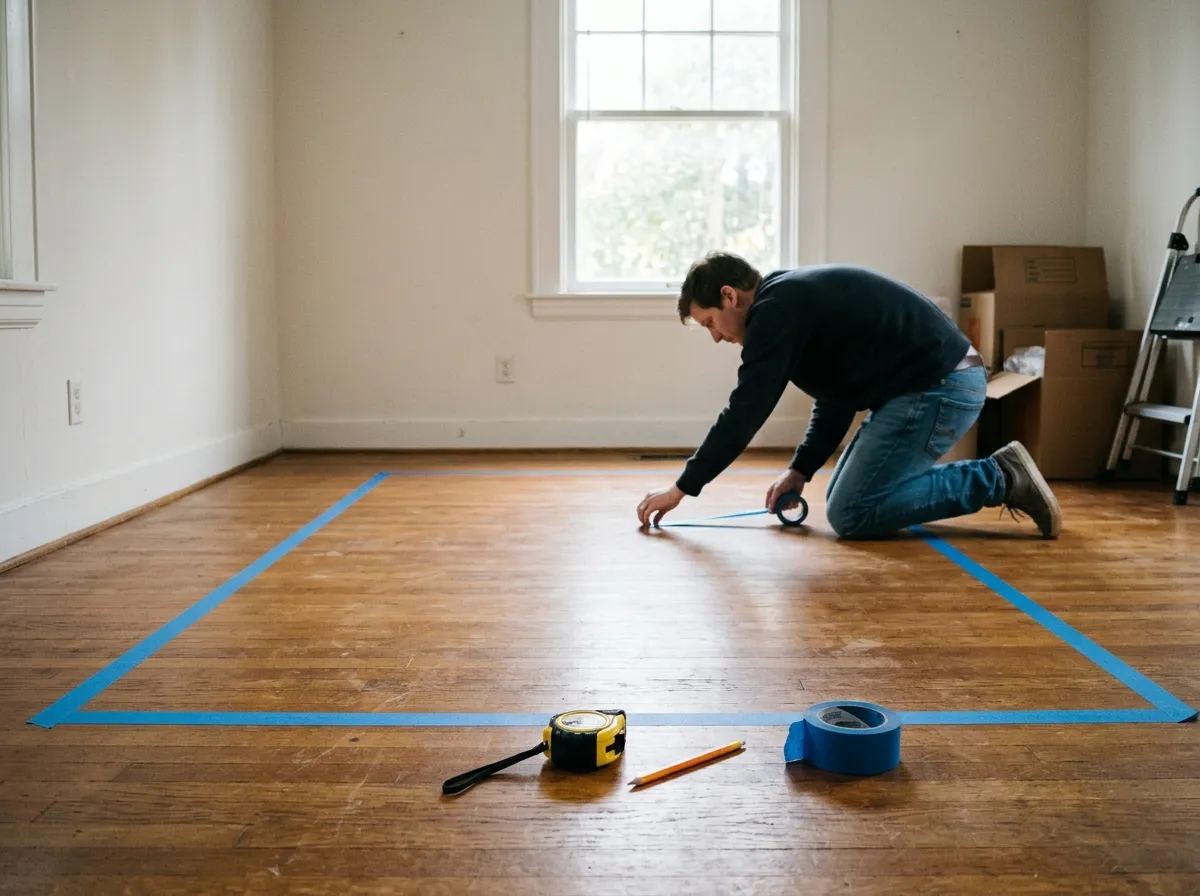
Taping the footprint also tells you whether the piece suits the room once it arrives. For a full to-scale plan, pair it with the Furniture Layout Planner, and use the Room Size Calculator to confirm how much floor you are working with. If the piece sits on a rug, check the Rug Size Guide as well.
Common mistakes
- Measuring the door, not the opening. A door labeled 32 inches wide leaves a narrower clear gap once the stop and hinges take their share.
- Using the showroom size. Feet, arms and pillows are often missing from the listed dimensions.
- Checking only the front door. The bedroom door, the stairwell and the elevator can be tighter.
- Looking at width only. A piece’s smallest side matters most at the door.
- Ignoring the margin. The checker leaves 1 inch at doorways and 2 inches on corners for a reason. Do not plan on a fit with zero spare room.
- Forgetting about hardware. Door handles, railings and radiators narrow a hall.
- Skipping the return policy. Many stores charge a restocking fee for large furniture, so check before you order.
- Assuming you can tilt it. The checker does not count on tilting. If you plan to rely on it, test it first.
Before you order: checklist
Tick these off before you click “buy.”
More questions
The most common questions are answered in the checker above. Here are a few more.
How much spare room does the checker leave?
At the doorway, each of the item’s two smaller sides must be at least 1 inch smaller than the opening, in total. For the hallway turn, the item’s longest side must be more than 2 inches shorter than the estimated limit.
Does the checker include stairs and elevators?
No. It tests one doorway and one simple right-angle hallway turn. Measure stairwells, elevators and ceiling height separately and run the checker again for each narrow point.
Why does the doorway check ignore the longest side?
Because a long item can be slid through end first. Only its two smaller sides have to fit through the opening, so those are the ones the checker tests.
What does “very tight or will not turn” mean?
It means the estimated limit for the corner is not clearly longer than your item. It is not a final no. Try removing legs or arms, test the turn with a taped outline, or choose a slimmer piece.
Ready to check your furniture? Scroll back up, enter your measurements and see the verdict before you buy. Once you know it fits, the next step is knowing how much floor space you have to work with.